Charles Williams
Under Your Spell: A Romance Boxed Set of Masked Balls, Haunted Gardens, Magic, and MoreCharles Williams is the older brother of Robert Williams, the husband of Anna Williams, and the heir apparently expected to take over his family’s mill. Though he appears only briefly in the surviving account, his choices organize the emotional crisis that follows the 1871 Peshtigo Fire: he plans a home and family with Anna, becomes separated from Robert during the catastrophe, and leaves Robert carrying both Anna’s welfare and the burden of what he knows about Charles’s final moments.
Identity and Family Position
Charles belongs to the Williams family of Sturgeon Bay and occupies the position that makes Robert feel permanently secondary. Robert explains that Charles is away at college in Chicago, completing an accounting certification at Northwestern, and expects that Charles—not Robert—will eventually run their father’s mill. The arrangement gives Charles social and economic precedence, but it also sharpens Robert’s private resentment. Robert’s knowledge of his brother’s expected future turns the family hierarchy into an intimate wound: the mill, the house, and Anna all seem to confirm that Charles is the one entitled to inherit the life Robert wants.
Charles is nevertheless presented as more than a symbol of privilege. When Anna visits the Williams workplace, she identifies him as Charles and offers her hand. He responds with surprise and pleasure, while admitting that he does not know who she is. The meeting marks the beginning of the connection through which Anna becomes his wife. Charles’s immediate warmth contrasts with the bitterness Robert struggles to suppress, making the brothers’ conflict less a contest over property than a painful divergence in how each man is able to imagine belonging.
Plans for Anna and the Burden of Duty
Charles has been preparing to leave Sturgeon Bay and build Anna a house where they can raise a family before winter. The plan gives their marriage a concrete future: a cleared parcel of land, a new home, and a household established before the frontier season turns harsh. Robert participates in that future despite his own feelings. He clears the neighboring land so Charles can begin building, and Charles thanks him with a genuine grin, acknowledging that Robert has made time for work that serves Charles’s domestic ambitions.
The project becomes complicated by an accident in the family. After their father suffers a fall that breaks his back and leg, Charles can no longer devote himself solely to relocating and building. He works longer hours at the mill, helps his mother care for their injured father, and still tries to return home to Anna as often as possible. His obligations divide him among work, parental care, and marriage. The evidence therefore frames Charles’s absence not simply as neglect but as the pressure of competing responsibilities, even though Anna experiences the absence through the more immediate language of waiting and loss.
Robert’s response reveals the emotional cost of Charles’s position. He envies his brother for living the life Robert longs for, yet he refuses to betray him. Clearing land, building furniture, and repairing his own cabin become practical ways to contain desire that cannot be acted upon. Charles’s marriage to Anna thus produces a triangle in which Charles is physically occupied by duty while Robert is psychologically occupied by longing and guilt. Charles does not need to threaten Robert directly; the life he is building is enough to expose what Robert believes he will never have.
The Peshtigo Fire and Disappearance
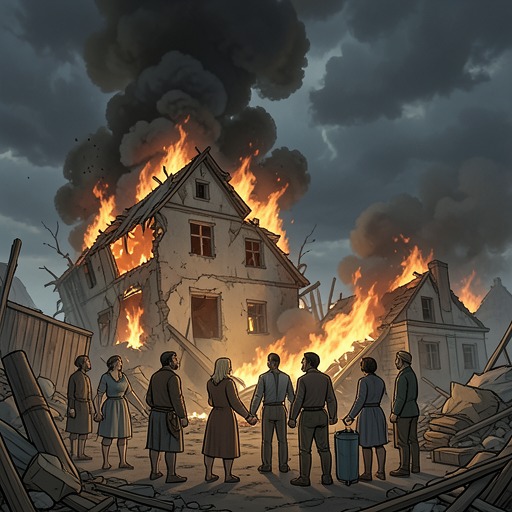
The 1871 Peshtigo Fire transforms Charles from an active future-maker into a missing figure whose fate must be inferred through survivors’ memories. Robert loses sight of him as soon as both men reach the water. Around them, flaming people, burning debris, branches, logs, and entire sections of homes fall into the bay. The firestorm makes ordinary forms of protection useless, and Robert can only hope that Charles’s quick thinking will preserve him, just as it has preserved Robert. His hope is connected immediately to Anna: Charles has someone to take care of, and that responsibility becomes the reason Robert imagines his brother fighting to survive.
The account later returns to the moment when the nightmare has quieted. Robert cannot erase the sight of Charles’s retreating back or the words Charles directed toward him: “Take care of her.” Robert had answered by shouting, “You can’t leave!” The flames around the brothers appear to form a protective circle that narrows as Charles moves away, turning Charles’s departure into an image of separation surrounded by apparently supernatural or apocalyptic force. Whether read as a literal vision within the fire or as Robert’s trauma-shaped perception, the scene gives Charles’s last act a precise ethical direction: he does not ask Robert to preserve the mill, the property, or the family name, but to care for Anna.
That request also exposes the unstable bond between the brothers. Robert has long resented Charles for marrying Anna, and the crisis revives an intense hatred he had held at bay. Yet Charles’s final words redirect Robert’s feeling from rivalry toward responsibility. The brother who seemed to possess everything leaves Robert with an obligation that is both intimate and punishing. Charles’s disappearance does not resolve Robert’s jealousy; it binds that jealousy to grief and makes every future act of care potentially inseparable from guilt.
Anna’s Grief and Charles’s Afterlife in Memory
When Robert reaches Anna after the fire, she immediately asks whether Charles has come and whether Robert was with him. Robert confirms that he got Charles out of the house and that they ran in search of their parents, but he stops before describing the collapsing roof, the consuming flames, and the desperate movement toward the bay. He cannot tell Anna everything he witnessed, including his interpretation that Charles chose death rather than continue into a life transformed by catastrophe. Charles is therefore present in the scene through silence as much as through speech: Anna receives an incomplete account, while Robert bears knowledge he cannot fully communicate.
The public accounting of the dead makes Charles’s absence official. At a mourning gathering, the mayor reads the names of the victims, first calling “Charles Williams” and then “Robert Williams.” Anna gasps when she hears them, and her mother takes her hand in an attempt to comfort her. The sequence places Charles’s name beside Robert’s, collapsing the distinction between the absent husband and the surviving brother in the communal record of catastrophe. For Anna, however, the names do not offer closure. Charles remains the person whose return she is waiting for, and Robert remains the man who knows why that return will not occur.
Charles’s characterization consequently depends on delayed presence. He is remembered through the house he intended to build, the family he hoped to raise, the work that prevented him from being home as much as he wished, and the final command that survives the fire. His narrative function is not merely to disappear so that Robert and Anna can continue; it is to make continuation morally difficult. Every effort Robert makes on Anna’s behalf can be understood as loyalty to Charles, compensation for Charles’s loss, or an extension of the desire Robert once tried to suppress.
Narrative Significance
Charles Williams embodies the fragile future that the fire destroys in a single historical disaster. Before the flames, his life is oriented toward consolidation: education leading to control of the mill, a marriage with Anna, and a house intended to secure a family before winter. After the flames, those plans survive only as obligations transferred to others. His position as older brother and future mill owner gives the tragedy a social dimension, but his relationship with Anna gives it its emotional center.
The contrast between Charles’s practical responsibilities and Robert’s concealed longing makes him a catalyst for both external action and inward conflict. Charles is caring enough to insist on Anna’s protection, burdened enough to divide his time among work and family, and absent enough for Robert’s resentment to grow in the gaps. His disappearance turns those gaps into permanent uncertainty. In the story’s moral architecture, Charles is remembered less by what he could have inherited than by what he entrusts: Anna’s safety, and with it the unresolved question of whether love can be honored without erasing the grief and desire left behind.